

 Wall fireplace
 Floor-standing fireplace
 XXL fireplace
 Suspended fireplace
 Ethanol stoves
 Table fireplace
 Burners
 Accessories
 Vertical
 Round
 Free-standing
 Horizontal
 Square
- Language:
- Account
 Français
 English
 Italiano
 Español
 Português
 Deutsch
 Nederlands
 Svenska
 Suomi
 Dansk

Bioethanol Fireplace Buying Guide and Comparison
A bioethanol fireplace offers a real flame without the need for a chimney or major construction work—provided you fully understand how it works, how much heat it provides, and how much it consumes during use. Wall-mounted, built-in, suspended, freestanding, or tabletop: each style is suited to a specific room and a particular way of enjoying a fire. Budget, safety, and reading the instruction manual are the final factors to consider when choosing the right model.
How does a bioethanol fireplace work ?
A bioethanol fireplace requires no connections—no vent and no gas line. This is what makes it possible to install it almost anywhere, but there is one drawback to keep in mind: the combustion byproducts remain in the room.
The burner produces a real flame
The heart of the unit is the burner, a chamber designed to burn an ethanol-based liquid fuel. A bioethanol fireplace therefore produces a real flame that visually dances and crackles like a wood fire, without embers or ash. With a manual burner, operation involves just four steps:
- Fill out The tank containing the approved fuel; the unit is cold.
- Turn on the fireplace, following the instructions in the manual.
- Adjust the flame, on certain models, using a sliding door.
- Turn Off using the fire extinguisher provided.
Since nothing is vented to the outside, the unit requires adequate room ventilation, which is discussed further below in the safety section.
Does it really heat a room ?
The combustion of bioethanol releases sensible heat, which is transferred to the air by convection and to nearby surfaces by radiation. However, it serves as a supplemental heating source rather than a primary one: the flame warms a corner of the living room for an evening, not an entire home.
Depending on the size of the room, the same burner may not provide the same level of comfort. Ceiling height, insulation, ventilation, flame adjustment, and duration of use all play a role, so the sensation of warmth varies from one home to another. The power rating listed on each model’s specifications sheet remains the best benchmark for comparing two fireplaces.
How is it different from an electric fireplace ?
An electric fireplace simulates a flame without any combustion, whereas a bioethanol fireplace offers a real fire. Depending on the model, an electric fireplace may include a heating element or be purely decorative.
The choice therefore depends first and foremost on the desired atmosphere. For a realistic flame, a bioethanol fireplace has the advantage—it requires no chimney or electrical outlet when using a manual burner. To heat a room to a stable temperature every day, a dedicated supplemental heater takes over.
Tabletop, wall-mounted, or freestanding bioethanol fireplace ?
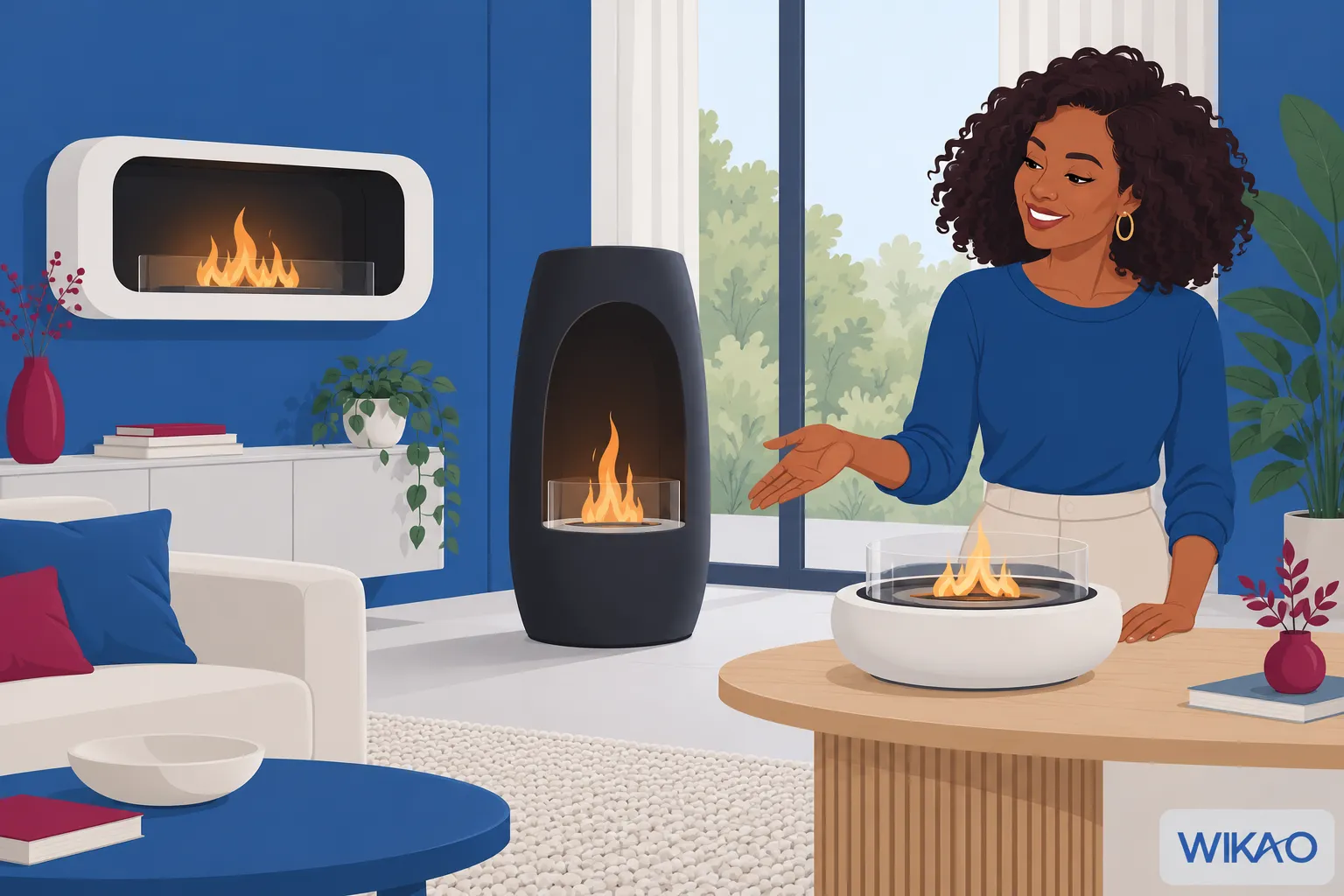
The design determines the installation, space requirements, and portability of the unit. Each type of fireplace is designed for a specific purpose: a fixed wall-mounted unit, a unit built into a niche, a suspended fireplace, or a model that can be moved from one room to another.
The wall-mounted bioethanol fireplace
A wall-mounted bioethanol fireplace is installed flush against the wall, leaving the floor completely clear, which gives the fireplace the appearance of floating. The shapes vary widely—vertical or horizontal rectangles, squares, rounded shapes, or picture-frame styles—as shown in the Catalog of Wall-Mounted Ethanol Fireplaces from Wikao. The number of burners and the width of the flame vary from one model to another, allowing you to choose a fireplace that fits the size of your wall.
With its flame at eye level, the wall-mounted bioethanol fireplace looks just as good in a living room as it does in a bedroom or office—anywhere a freestanding fireplace would take up too much space.
Before choosing the location for the fireplace, check the type of wall, the clearance around the unit, and the heat resistance of the surrounding finishes. A solid concrete wall can accommodate standard anchors, while a hollow drywall partition requires specialized anchors, such as Molly anchors. Some models come with a glass panel or a grille, which limits access to the flame but does not eliminate the risk of burns.
Built-in or wall-mounted bioethanol fireplaces
A built-in bioethanol fireplace can be installed in a niche or cabinet for a very sleek look. The instruction manual specifies the dimensions of the niche, compatible materials, any required ventilation, and access to the burner. For a fireplace with a rear cabinet, a properly sized opening and fire-resistant drywall—rather than standard drywall—ensure a durable installation.
A wall-mounted bioethanol fireplace is installed on the ceiling according to the specific instructions for that unit. In a rental or condominium unit, any installation—such as recessed mounting—requires a prior review of the lease or condominium bylaws.
A bioethanol fireplace with a stable stand
Conversely, a freestanding ethanol fireplace requires no permanent mounting and can be moved to another room once it has been turned off and has cooled down, just like the models from the range of freestanding ethanol fireplaces and stoves. To breathe new life into the hearth of a traditional fireplace that is no longer in use, Wikao also offers renovation solutions that can be installed directly into the existing fireplace.
Even more compact, the tabletop bioethanol fireplace is primarily decorative. To enhance the ambiance of your living room, place it on a stable, heat-resistant surface away from fabrics, and monitor the heat transferred to the furniture during the first few uses of a small tabletop ethanol fireplace. Avoid areas with heavy foot traffic and direct drafts.
How much does an ethanol fireplace cost ?
The cost of an ethanol fireplace consists of two parts: the purchase price of the unit and the fuel consumed over the course of several evenings. The tank’s capacity links these two, since it determines how often you’ll need to refill it.
Factors Affecting the Purchase Price
The purchase price of a bioethanol fireplace depends on its size, dimensions, materials, burner type, tank capacity, and safety features. A wall-mounted or built-in model may require some minor installation or finishing work, whereas a freestanding model is ready to use right out of the box.
In addition to the unit itself, an automatic fireplace requires an electrical connection or batteries, and each burner requires regular maintenance. The price listed on the product page at the time of purchase remains the only reliable reference.
The price of fuel per use
The cost of a night's use is calculated simply: the burner's hourly fuel consumption multiplied by the duration of use, then by the price per liter of fuel. The hourly fuel consumption is listed in the instruction manual for each model and varies depending on the flame setting.
It all depends on the type of flame you're looking for: a low flame for ambiance uses significantly less fuel than a flame set to maximum. The price per liter, on the other hand, varies depending on the packaging and when you buy it, which is why it's a good idea to recalculate this based on your own habits.
Tank Capacity and Range
The theoretical burn time is calculated by dividing the volume of liquid poured into the tank by the hourly consumption rate. For example, a burner that consumes 0.25 L per hour will burn for 4 hours with 1 L of liquid, although this does not represent a precise model.
A large reservoir therefore only extends the burn time when consumption is comparable. For the same bioethanol fireplace, a smaller flame makes the same volume of liquid last much longer than a fully open flame.
Point to note: The heat released by the fuel does not remain entirely in the room. The necessary ventilation removes some of this heat, which reduces the actual level of comfort achieved per liter burned.
Is a bioethanol fireplace dangerous ?
When used properly, a bioethanol fireplace blends seamlessly into everyday life. However, since it involves a real flame fueled by a flammable liquid, there are a few simple rules to follow regarding refilling, keeping people at a safe distance, and ventilating the room.
Fuel and Refueling
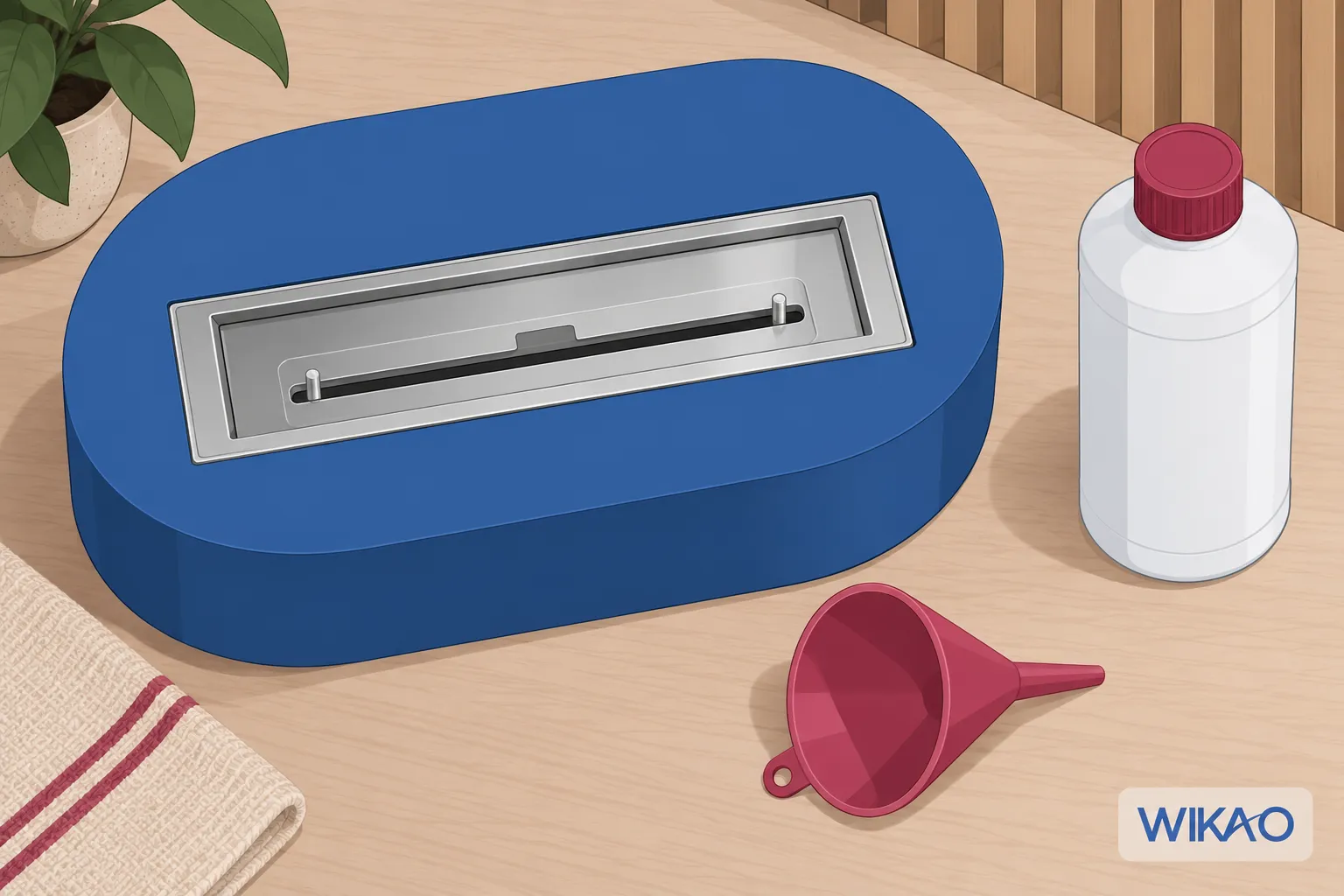
Ethanol is a highly flammable liquid whose vapors ignite easily, even at room temperature. Therefore, refilling must follow three rules:
- For cold use only : After the flame has been extinguished and the burner has cooled completely; never use on a hot burner.
- The Right Fuel : the one authorized by the instructions, in accordance with the procedure outlined therein.
- The maximum level : Never exceed this limit, as an overflow could set clothing, furniture, or a surface on fire.
These precautions should be followed during storage. Store bioethanol in its original container, tightly closed, out of the reach of children, and away from any heat sources.
Furthermore, the ethanol fuel sold at gas stations is not interchangeable with the fuel used in a fireplace burner: the biofuels for vehicles are not intended for this use.
The Flame and Loved Ones
A lit fireplace should never be left unattended. Children, pets, curtains, and nearby furniture increase the risk of contact with or the spread of fire; a protective glass screen limits access to the flame, but does not prevent burns from contact with hot surfaces.
When installing the fireplace, keep the area around it clear and place it away from high-traffic areas. A smoke detector and a carbon monoxide detector in the room are useful additions to these safety measures, since the smoke detector cannot detect carbon monoxide.
Indoor Air Quality and Ventilation
Carbon monoxide can be produced during incomplete combustion, even in the absence of visible smoke. During normal operation, the flame consumes oxygen and releases carbon dioxide and water vapor into the room, which is why it is important to ventilate the room.
The appliance's instruction manual remains the definitive guide for the minimum room volume and the required ventilation. Leaving a window slightly open during use and ventilating the room thoroughly after the party are good habits to adopt, as is keeping the burner clean, which promotes even combustion.
What factors should you consider before making a purchase ?
A nice photo isn't enough to compare two fireplaces. The user manual and the type of burner provide the concrete details that make a difference in everyday use.
The instruction manual and compatible fuel
A comprehensive instruction manual specifies the permitted fuel, power output, fuel consumption, minimum room volume, clearance requirements, ventilation, and the refueling procedure. Three points deserve careful consideration:
- Fuel : the one recommended for the burner; a higher ethanol content alone does not guarantee cleaner combustion.
- Additives and Fragrances : only if the manufacturer approves them for use with this burner.
- Dimensions : width, height, depth, weight, any required niche, and safety distances.
Measuring these dimensions on each model allows you to compare truly comparable appliances and then verify that they will fit in your home.
The manual or automatic burner
An automatic burner controls the fuel supply and ignition; depending on the model, it also adjusts and extinguishes the flame, powered by an electrical outlet or battery. For any burner, check the capacity, leak-tightness, accessibility, shut-off mechanism, and overflow protection; even a large capacity does not exempt you from adhering to the maximum level.
Once the burner is installed, its safety features make all the difference in everyday use: protection against overflow, overheating, and hot refilling; reliable shut-off; and proper behavior in the event of a power outage for automatic models. In a steel structure, the thickness of the metal and the quality of the joints matter more than the material’s name alone.
If you have any questions about the location, size, or type of burner that's right for your room, please contact customer service Wikao, who can be reached by phone, provides guidance both before the purchase and after installation.
Related posts
-
 How can you reduce your electricity bill this winter?Winter is here, and although the temperatures are mild this year, the nights are still very chilly - especially if...Read more
- Including the purchase of a fireplace in your mortgageOwning a fireplace has many advantages: it looks good, it's useful and it's an excellent investment over time...Read more
- What's the best auxiliary heater in the event of a power cut?There is a risk of power cuts in France this winter. France's electrical capacity is not at its optimum level. The...Read more
- How to choose an ethanol fireplaceFor several years now, ethanol heating has offered a reliable and economical alternative for supplementary heating....Read more
- Nomadic bio-ethanol fireplaces on M6Today, in the programme Bien chez soi, broadcast on M6, we talk about bio-ethanol fireplaces. Sophie Ferjani presents...Read more